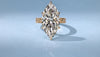
Mastering Brilliance: Exploring the Unique Facets of Portuguese Cut Diamonds
A Portuguese-cut diamond has an undeniable charm. Their stacked facets, deep light refraction, and old-fashioned image attract people who appreciate finer details above everything else. If you’re curious about what makes this cut special or planning to buy a Portuguese-cut lab grown diamond ring, you’re about to discover a gem with rich artistic heritage.
To understand what makes this cut so distinctive, we’ll explore the origins of the Portuguese-cut diamond, how it’s shaped, and why it stands apart from modern designs.
Explore Portuguese Cut Diamond Engagement Rings
Where Did the Portuguese Cut Diamond Originate?
The Portuguese-cut diamond has its roots in Portugal in the early twentieth century. Jewelers loved light, and they tried to work with the new methods of making stones shine. Their answer was a pattern consisting of numerous little facets in layers. Light had to penetrate through the rock, remain, and come back through the crown in a soft glitter.
The style was diffused across Europe and was eventually acquired by collectors who appreciated diamonds with personality rather than symmetry alone. That is why Portuguese-cut diamonds are still the favorites among those who like to wear jewels inspired by antiques.
This gives way to how the diamond is made and the reason why the faceting of the diamond affects its brilliance.
The Portuguese Cut: How is it shaped?

The Portuguese-cut diamond is known to have a round design as well as multiple facets; it is a classic diamond that has three rows of facets on the crown and three on the pavilion, which makes the stone look textured and layered. The design forms a gradual, romantic form of brilliance compared to the sharp flashes seen in modern round brilliant cuts.
Some Portuguese-cut diamonds even have over one hundred facets. Some have the highest limit of one hundred and forty-five. This makes them interesting to view in detail, particularly in natural lighting.
You get to know about its optical behavior, the more you know about it, the more you realize what makes this cut stand out among the rest.
Light Behavior and Sparkle
If you have ever admired candlelight in an old mirror, you already know the atmosphere that Portuguese-cut diamonds create. The facets hold the light in shallow spots, scatter it gently, and produce a radiance instead of a glitter. That is why the cut is the best one to be offered to people who like to have fine radiance rather than extreme brightness.
The additional dimensions add fire, which is the colored sparkle that the diamonds give out under specific lighting. You will see reds, golds, and deep blues, particularly in the evening. Portuguese-cut diamonds provide such a visual experience that it is personal to jewelry lovers who are romantically inclined and sentimental.
With its unique light properties in mind, let us explore how this cut appears in jewelry today.
Explore Our Handpicked Designs
- Portuguese Cut Lab Grown Diamond Engagement Rings
- Portuguese Moissanite Engagement Rings
Contemporary Jewelry and the Portuguese Cut

The Portuguese cut is highly suitable with most types of jewels, although the most desired one is the Portuguese-cut diamond engagement ring. Its circular design is set in a solitaire environment, with halos and an old-style gallery in filigree. The cut is popular among collectors who like the combination of the milgrain lines, tapered baguettes, and low-domed settings.
In case you want something simple, earrings are a classy option too. If you wear Portuguese-cut diamond studs, you’ll notice light reflecting indoors in a really soft manner. Pendants with this type of diamond cut feature lovely details on the neckline for those who prefer bolder pieces.
This leads to the increased popularity of lab grown Portuguese-cut diamonds.
The Emergence of Portuguese-Cut Lab Diamonds

Portuguese-cut diamonds that are grown in labs have become popular in recent years. They provide the same structure of the facet, optical properties, and durability at a price that is easily affordable. A Portuguese-cut diamond price will vary based on size, clarity, and number of facets, yet lab grown options allow you to explore larger stones without compromising quality and within the same budget.
Another reason why collectors prefer lab grown Portuguese-cut diamonds is for their ethical benefits. With a traceable origin and conflict-free sourcing, they offer peace of mind for environmentally conscious buyers while remaining just as beautiful.
The next concern that follows is how to style these stones and we’ve got you covered in our next section.
Styling Ideas for Portuguese-Cut Diamonds
If you value the traditional design, then a Portuguese-cut diamond ring with a simple round solitaire is eternal. In case you are in love with romantic jewelry, a halo made with small accent stones adds dimension. Are you looking for a style that expresses boldness? A Portuguese-cut diamond engagement ring in yellow gold can provide warmth and a royal touch.
Studs or pendants are good when there is every day use. They are effortless and sophisticated enough to take your look to the next level.
When you know how to wear these stones, it is easy to understand why people still want them.
Design Your Dream Portuguese Cut Diamond Ring
Experience unmatched brilliance with a handcrafted Portuguese cut diamond ring from Diamondrensu. Customize every detail to create a piece that’s truly yours - timeless, unique, and made to shine.
Create Your Custom RingFrequently Asked Questions
1. Why are Portuguese cut diamonds so sparkly?
Portuguese cut diamonds have extra facets compared to traditional cuts, allowing more light to reflect internally, creating a dazzling and fiery sparkle.
2. Are Portuguese cut diamonds more expensive?
They can be slightly more expensive due to the complex cutting process and higher material loss, but pricing depends on carat, clarity, and quality.
3. Is a Portuguese cut better than a round brilliant cut?
It depends on preference. Portuguese cuts offer more sparkle and uniqueness, while round brilliant cuts are more traditional and widely recognized.
4. Do Portuguese cut diamonds look bigger?
Not necessarily. Due to deeper cuts and extra facets, they may appear slightly smaller than other diamonds of the same carat weight.
5. Are Portuguese cut diamonds rare?
Yes, they are relatively rare because they require skilled craftsmanship and are not mass-produced like standard diamond cuts.
6. What gemstones can have a Portuguese cut?
Besides diamonds, this cut is commonly used for amethyst, topaz, quartz, and other transparent gemstones.
7. How many facets does a Portuguese cut diamond have?
Typically, it has over 100 facets, significantly more than the 57–58 facets in a round brilliant cut.
8. Is a Portuguese cut diamond worth it?
If you value maximum sparkle, uniqueness, and craftsmanship, a Portuguese cut diamond is definitely worth considering.
Conclusion
Portuguese-cut diamonds have something modern cuts do not necessarily have. Their multi-layered facets, historical appeal, and lighting character traits would be ideal to anyone who seeks a delightful combination of art and history in their jewelry.
Diamondrensu celebrates lab grown diamond cuts that tell stories. We blend expert craftsmanship, ethically sourced lab grown diamonds, and thoughtful personalization for those who desire meaningful jewelry, like you.
From Portuguese-cut diamond rings and solitaire studs to a tailor-made engagement ring, we craft every piece that is specifically designed to match your style. With precision-driven artistry by experienced craftsmen and dedicated guidance, we help you choose a diamond that truly feels right.
Want to explore some other options

Leave a comment
Please note, comments must be approved before they are published.