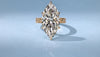
What Makes Marquise Engagement Rings a Good Option?
Table Of Contents
- What is a Marquise Cut Diamond?
- The History and Origin of the Marquise Cut
- Why Choose a Marquise Diamond Ring?
- Pros and Cons of Marquise Diamonds
- Popular Marquise Diamond Ring Designs
- Marquise Diamond Ring Settings Explained
- Carat and Size Guide for Marquise Diamond Rings
- Key factors to consider: Use the scorecard on two listings
- Marquise Lab Grown Diamond Wedding and Engagement Rings
- Care and Maintenance for Marquise Diamond Rings
- Budget and Pricing Factors
- Why Buy Your Marquise Diamond Ring from Diamondrensu?
- Conclusion
- FAQ
You've seen the photos of marquise diamonds, elongated, elegant, unmistakably different. A marquise engagement ring catches your eye in ways a round diamond never could. But then the doubts creep in. What about those pointed tips? Will it snag on everything? Does that dark shadow down the center mean something's wrong?
This isn't about whether marquise diamonds are universally "good." It's about whether a marquise diamond engagement ring fits your actual life, how you use your hands, whether you'll remember to check the prongs, how you want to split your budget, and whether you're willing to baby the tips a bit. The answer changes depending on what else you're considering and what you're willing to live with.
What is a Marquise Cut Diamond?
Picture an almond or football shape (American football): an elongated diamond with pointed ends and a curved middle. It often looks larger face-up than a round at the same carat because it spreads length, but the effect depends on balanced proportions.

Key geometry: tips, belly, and length-to-width
Three elements define the look of a marquise diamond: the two tips, the widest ‘belly,’ and the length-to-width ratio. That ratio sets the stone’s overall character, from fuller to more slender.
How brilliance behaves in elongated shapes
Light enters through the top, bounces around inside the diamond, and ideally comes back to your eye. When the bottom half is too shallow or too deep, light escapes through the bottom instead. You get dead zones. Or you get that bow-tie effect, a dark band across the center. Some degree of bow-tie shows up in most elongated shapes, but it shouldn't dominate what you see when you look at the ring.
Marquise stones are more sensitive to both cut and setting. If the cut isn’t balanced, the bow-tie becomes distracting; if the tips aren’t protected, they’re more vulnerable to impact. Prioritize millimeter dimensions and real-life sparkle over a single flattering photo.
The History and Origin of the Marquise Cut
The cut supposedly dates back to 18th-century France. King Louis XV allegedly commissioned a diamond shaped like the smile of his mistress, the Marquise de Pompadour. Whether that's true or just a good story, it explains why the shape got linked to elegance and femininity. The cut had a moment in the 1970s, and it's having another one now.
Unique Design Collection


Why does vintage marquise look different than modern
Older marquise diamonds often have higher crowns, bigger tables, and slightly different angles than what you see in modern stones. Those vintage pieces were hand-cut with less precision. Sometimes that creates warmer light, sometimes it creates more obvious bow-tie or lopsided proportions. Modern diamond cutting tech allows tighter control, but tighter control doesn't automatically mean better sparkle; it just means more options.
Why Choose a Marquise Diamond Ring?
A marquise diamond engagement ring often wins on presence: it can look longer on the finger and offer generous face-up coverage for the budget. When the cut looks lively and the setting protects the tips, the choice becomes less about trend and more about lifestyle fit.
Pros and Cons of Marquise Diamonds
A marquise cut engagement ring can deliver a lot of visual length. Its outline can also feel elegant and slightly vintage, even in a modern setting. Many buyers like the finger elongation effect, especially on smaller hands.
Standard prongs hold the stone at four or six points, but marquise tips need better coverage. V-prongs cradle each point and distribute force more safely than rounded tip prongs.

Popular Marquise Diamond Ring Designs
Solitaire: clean look, higher responsibility
A solitaire lets the marquise speak for itself. Four or six prongs hold the stone with nothing else getting in the way. Maximum light, elegant, timeless. But you're also taking on full maintenance responsibility. No halo to cushion the edges. No side stones to absorb a knock. If a prong loosens or a tip chips, it's immediately obvious.
Solitaires work when you're committed to checking the ring regularly, and your hands don't bash into stuff constantly.


Halo: visual amplification and edge protection tradeoffs
A halo design wraps the marquise with smaller diamonds, making it look bigger and adding sparkle. Halos also create a buffer between the marquise tips and whatever you're bumping into, which can reduce chip risk.
The catch: halos add complexity. More cleaning effort. Potential snag points if the design sticks out too much. A poorly done halo catches on fabric and hair. A well-designed one sits low and hugs the center stone closely.


Three-stone: balance, meaning, snag considerations
Three-stone settings flank the marquise with two side stones, usually rounds, pears, or smaller marquises. It balances the composition and carries that "past, present, future" symbolism. The side stones can shield the marquise tips if positioned right, but they also make the ring wider and taller overall. Wider rings are more likely to snag or feel bulky when you're trying to do things.


Marquise Diamond Ring Settings Explained
Prongs vs V-style protection: where damage happens
Standard prongs grab the diamond at four or six spots. At the marquise tips, rounded prongs can slip off under pressure, leaving the point exposed. V-prongs wrap around the tip in a protective cradle, spreading force more evenly.
If you’re hard on jewelry, treat V-prongs (or a bezel edge at the tips) as a protective design, not an upgrade.
Bezel and semi-bezel: protection with visual tradeoffs
Bezels offer maximum protection by wrapping the stone in metal; semi-bezels cover the tips while leaving the sides open. The tradeoff is a slightly bolder look and a bit less edge-to-edge ‘spread’ because metal overlaps the outline.
Low vs high profile: snag risk and comfort
High settings make stacking easier, but snag more often. Low profiles sit closer to the finger for comfort and fewer catches, though they can complicate band pairing. For hands-on lifestyles or frequent glove wear, a low-profile design with tip protection is the safest option.
Carat and Size Guide for Marquise Diamond Rings

Carat vs millimeters: what you actually see
Carat measures weight; millimeters describe what you actually see. Two stones with the same carat can look noticeably different face-up depending on their dimensions, so compare length and width, not carat alone.
Length-to-width ratio and visual personality
Ratio changes the personality of the marquee diamond: around 1.75:1 looks fuller, around 2:1 looks slender and dramatic. Most buyers prefer roughly 1.85:1 to 2.0:1, but your finger size and taste decide what feels balanced.
Spread tradeoffs: shallow vs deep pitfalls
Shallow stones can look larger but leak light and lose sparkle; overly deep stones can sparkle more but look smaller face-up. Use depth numbers as a reference, but judge performance with real-life optics.
Sizing choices force priority tradeoffs
If size is the priority, set a millimeter target first and use carat as the budget constraint. Aim for a balance of spread and sparkle, slightly smaller with better optics often looks better than larger but dull.
Key factors to consider: Use the scorecard on two listings

Decision stack: must-haves vs nice-to-haves
Start with non-negotiables: tip protection, proportions that keep bow-tie under control, a profile height that suits daily wear, and maintenance you’ll realistically do. Then choose nice-to-haves (ratio preference, halo framing, matching bands) based on what’s left in the budget.
Quality signals that matter most for this shape
For marquise lab grown diamond engagement rings, how the stone performs beats what's on paper. A marquise with great proportions and a minimal bow-tie can outshine a higher-graded stone with lousy symmetry or a dark zone you can't ignore.


Scorecard: rank options under constraints
Use this to evaluate any marquise:
Marquise Ring Scorecard (use once per listing)
- Tip protection present: V tips or bezel edge on both points (Yes or No)
- Setting profile height: low enough for daily wear comfort (Low, Medium, High)
-
Millimeter dimensions listed: length and width both stated (Yes or No)
- Length to width preference: within your comfort band, such as 1.75 to 2.10 (Yes or No)
-
Optics media provided: straight on video under normal lighting (Yes or No)
- Symmetry check: tips align, and belly looks balanced (Pass or Recheck)
- Maintenance tolerance match: willing to check prongs every few months (Yes or No)
- Budget split: enough budget left for a protective setting and skilled labor (Yes or No)
Compare two listings line by line. One may win on size while the other wins on tip safety and optics. Seeing the tradeoffs in one place makes the decision easier.
A ‘ lab grown diamond marquise engagement rings’ search becomes less about scrolling and more about filtering. The scorecard makes the filter rules visible.
Marquise Lab Grown Diamond Wedding and Engagement Rings


Stacking fit: gap, flush, or contour choices
Wedding bands pair with marquise rings in three ways. A straight band leaves small gaps at the curves; some people hate that visual. A curved band wraps around the marquise, creating a flush look. A custom band matches the curves exactly, no gaps. Each changes the overall profile and how comfortable the ring feels during normal wear.
Daily wear in pairs: comfort and snag reality
Two rings change how they sit and how they interact with your environment. Stacked rings mean more total height, which catches on sleeves and gloves more than a single ring. They also create crevices where soap and lotion build up.
If you're planning to wear both daily, factor in extra cleaning and snag exposure.
Care and Maintenance for Marquise Diamond Rings
Maintenance is boring until a prong loosens at the wrong time. Marquise tips and prongs take repeated micro-impacts, so simple, regular checks significantly reduce loss risk.
If you wear the ring daily, plan routine checks: a quick visual scan weekly and a jeweler inspection every few months (especially after travel or heavy activity). Catching a loose prong early is far cheaper than replacing a lost stone.
For a buyer wearing marquise engagement ring styles every day, remove the ring during predictable high-risk moments. Remove the ring during gym sessions, deep cleaning, and heavy lifting. Those moments create the highest chance of tip impact.

Budget and Pricing Factors
A marquise budget has three parts: the diamond, the setting, and the labor. When timelines are tight, also factor in policies and insured shipping so surprises don’t derail delivery.
In that same budget frame, marquise lab grown diamond engagement ring listings can vary widely, even at similar carat weights. A cleaner cut and strong setting labor can cost more, but the extra spend can buy peace of mind.
Why Buy Your Marquise Diamond Ring from Diamondrensu?
At Diamondrensu, we design and craft rings in-house, focusing on lab grown diamonds and moissanite, and offer IGI/GIA certificates for added assurance. Our customization process helps you choose practical details, tip protection, profile height, and band fit, and is supported by insured shipping and straightforward return terms for eligible items. If you want a marquise that’s dramatic on the finger and practical day-to-day, we’re ready to build it with you.
Conclusion
A marquise ring can be a smart choice when it matches your lifestyle. Tip protection, millimeter dimensions, and a setting profile that fits daily wear matter more than a perfect photo. The marquise shape looks bold, but it rewards practical planning.
If you want elongation without worrying about points, an oval can feel easier to use. If you want the simplest buying path, a round diamond still wins for most buyers.
Before buying, run one last check: “Do tip photos, millimeter dimensions, and a straight-on video all match?” That decision rule can save you from a beautiful ring that feels fragile later.
One more note for buyers comparing lab grown diamond marquise engagement rings: choose the option that fits your story and your routine. Then ask for the proofs that remove doubt.
Ready to Create Your Own Jewelry?
Experience the luxury of storytelling through jewelry at Diamondrensu. Our master craftsmen specialize in custom creations, turning your most cherished visions into a brilliant, handcrafted reality.
START YOUR DESIGNFAQ
1. What is a marquise cut diamond?
A marquise cut diamond has an elongated shape with two pointed ends. The marquise shape can look long on the finger and make a strong impression.
2. Do marquise diamonds look bigger than round ones?
Marquise diamonds often appear larger face-up for the same carat weight. Face-up size depends on millimeter dimensions and cut, not just carat weight.
3. What settings work best for marquise diamonds?
Prongs with V tip protection, halos with strong tip coverage, and bezels are common choices. Tip coverage matters because tips take the brunt of the impact first.
4. Is a marquise diamond ring good for an engagement ring?
A marquise can work well when the setting protects both tips, and the buyer accepts basic maintenance. Active daily wear calls for a lower profile setting in most cases.
5. How do I choose the right size marquise diamond?
Use millimeter length and width as the primary size guide. Then choose a length-to-width ratio that feels comfortable in the hand.
Many shoppers compare marquise diamond engagement rings with ovals at this stage. That comparison can reveal whether points feel exciting or stressful.

Leave a comment
Please note, comments must be approved before they are published.