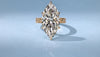
The Ultimate Guide to Engagement Ring Prong Settings
Key Takeaways
- Prong settings are the most popular engagement ring style because they maximize diamond brilliance by exposing the stone to light from all angles.
- 4-prong settings show more of the diamond; 6-prong settings offer greater security, especially for larger carat weights.
- V-prongs are designed specifically for pointed diamond shapes like princess, marquise, and pear cuts.
- Platinum is the most durable metal for prongs; white gold, yellow gold, and rose gold each offer distinct aesthetic benefits.
- Regular inspections every 6–12 months keep prongs secure and your diamond safe.
- Diamondrensu handcrafts every prong setting from scratch in Surat, India, using 100% conflict-free lab-grown diamonds and moissanite.
Most people start their engagement ring search focused entirely on the diamond. The carat weight, the cut, the sparkle. What gets overlooked, at least at first, is the setting. Specifically, the prongs.
Prongs are the small metal tips that hold your diamond in place. They look simple, but they do a lot of work. They determine how much light reaches your stone, how secure it stays over years of daily wear, and how the overall ring looks from every angle. Get the prongs right, and your diamond appears to float above the band in a halo of light. Get them wrong, and even a beautiful stone can look awkward or feel uncomfortable.
Prong settings have been the dominant choice in engagement ring design for well over a century—and for good reason. They offer a combination of security, brilliance, and versatility that no other setting style can match. This guide covers everything you need to know: the types of prong settings available, how each prong shape affects the look of your ring, which metals hold up best over time, and how to choose the right configuration for your diamond and your lifestyle.
What Are Prong Settings in Engagement Rings?
A prong setting is a jewelry technique that uses small metal projections, the prongs, to grip and secure a center stone. Before the diamond is placed, the prongs stand upright from the base of the setting. Once the stone is aligned, the prongs are bent inward and burnished against the crown of the diamond, locking it firmly in place.
The result is an open, airy structure that leaves the sides of the diamond exposed and lifts it above the band. From the top, you see the edge of each prong. From the side, you see the diamond itself, not a wall of metal surrounding it. This is precisely why prong settings are so widely used in modern engagement rings. The stone is the star, and the setting steps back to let it shine.
Prong settings are sometimes called claw settings, particularly when the prong tips are pointed. The two terms are often used interchangeably, though "prong" is the more common term in American jewelry design.
Why Prong Settings Are So Popular
The answer comes down to light. A prong setting exposes more of the diamond's surface than any other style, allowing light to enter from multiple angles and bounce off the facets. This produces the fire, brilliance, and scintillation that make a diamond so captivating. A lab-grown diamond set in a well-crafted prong setting will outperform the same stone placed in a bezel or channel setting when it comes to raw sparkle.
Beyond light performance, prong settings work with nearly every diamond shape. Round brilliant, oval, cushion, pear, marquise, princess- all of them look stunning in a prong setting. The design adapts to the stone rather than imposing a rigid frame around it.
There is also a cost advantage. Because prong settings use less metal than enclosed styles like bezels, they are often more affordable to produce. That means more of your budget can go toward the diamond itself, a real benefit when you are shopping for a lab-created diamond and want to maximize carat weight and quality.
Types of Prong Settings for Engagement Rings
4-Prong Setting
The 4-prong setting is the most widely chosen configuration. Four prongs are set at equal intervals around the diamond, creating a balanced, open look that exposes as much of the stone's surface as possible. Round and square cuts, particularly round brilliant and princess cuts, look exceptional in a 4-prong setting.
The trade-off is security. Four prongs provide solid support for most diamonds, but if one prong loosens or breaks, the stone has less redundancy than it would in a 6-prong design. That said, a well-made 4-prong setting from an experienced jeweler is more than adequate for everyday wear. Many people prefer the cleaner, more open look it creates.
6-Prong Setting
Six prongs give a round diamond a distinctly circular profile. The additional prongs accentuate the stone's roundness and provide an extra layer of security, which is why this configuration is often recommended for larger carat weights. The iconic Tiffany Setting, introduced in 1886, uses six prongs, a design choice that has influenced engagement ring aesthetics ever since.
The downside is slightly more metal coverage. Six prongs cover a bit more of the diamond's surface than four, which can reduce the amount of light entering from certain angles. For most buyers, this is a minor consideration compared to the added peace of mind.
3-Prong Setting
Less common than its four or six-prong counterparts, the 3-prong setting is used primarily in minimalist and modern designs. It creates an open, lightweight appearance and is often paired with pear or trillion cuts. The obvious limitation is security; three prongs provide less redundancy, so the loss of a single prong is more consequential. It is a beautiful option for the right design, but not the best choice for someone who wants maximum peace of mind.
V-Prong Setting
Pointed diamond shapes have sharp corners that are vulnerable to chipping. The V-prong setting addresses this directly. Instead of a round or claw tip, the prong wraps around the corner of the diamond in a V-shape, cradling the point and protecting it from impact. Princess, marquise, and pear cuts all benefit from V-prongs at their pointed ends.
Visually, V-prongs give a ring a crisp, tailored look. They follow the diamond's silhouette closely, making the stone's shape feel more intentional and defined.
Double-Prong Setting
A double-prong setting places two slim prongs at each corner of the diamond rather than one. This adds structural strength and creates a more intricate, architectural aesthetic. Cushion and emerald cuts are particularly well-suited to double prongs, as the style complements their geometric character. Double prongs have also seen renewed interest among buyers drawn to vintage-inspired designs.
Prong Shapes and Their Impact on Design
The number of prongs is only part of the decision. The shape of the prong tip itself has a meaningful effect on the ring's overall character.
Round Prongs
Round prongs, sometimes called button prongs, look like small beads or dots when viewed from above. They have a soft, traditional appearance that blends into the background and lets the diamond take center stage. This is the most common prong style in engagement rings, and it works particularly well with round brilliant and oval cuts. From a practical standpoint, round prongs are less likely to snag on fabric than pointed styles.
Pointed Prongs
Pointed or claw prongs taper to a fine tip over the diamond. They offer a sharper, more defined look that suits both modern and vintage-leaning designs. Because the tip covers less of the stone's surface, claw prongs can make a diamond appear slightly larger. They complement elongated shapes, oval, pear, and marquise; particularly well, as the pointed tips follow the stone's silhouette and give it a more defined, elongated feel. The trade-off is a higher tendency to catch on clothing or hair if the prongs are not perfectly flush with the diamond.
Flat Prongs
Flat or tab prongs have a squared-off, rectangular tip. They are less common than round or claw styles, but they offer a secure grip and a sleek, geometric aesthetic that suits contemporary designs. An Art Deco-inspired ring with an Asscher cut and flat prongs is a good example of how this style can enhance a specific design language.

How Many Prongs Are Best for Your Diamond?
There is no single right answer, the best prong count depends on your diamond's size and shape, plus how you live your life.
Diamond size matters most here. For stones under 1.5 carats, a 4-prong setting is generally sufficient and gives you the cleanest, most open look. Once you move into the 2-carat range and above, the added security of six prongs becomes more appealing. The larger the stone, the more weight the prongs must support, and the more consequential it would be to lose the diamond if a prong failed.
Diamond shape is the other key factor. Round brilliants work beautifully in both 4-prong and 6-prong settings. Fancy shapes with pointed corners, princess, marquise, pear, need V-prongs at those corners regardless of the total prong count. Square or rectangular cuts like emerald and Asscher often look best with double prongs at each corner.
Your lifestyle plays a role, too. If you work with your hands, exercise frequently, or simply want to minimize maintenance, six prongs offer more redundancy. For someone with a less active routine who prioritizes the look of the ring above all else, four prongs are a perfectly sound choice.
Prong Settings vs Other Engagement Ring Settings
Prong vs Bezel Settings
A bezel setting wraps a thin rim of metal around the entire perimeter of the diamond. It offers the highest level of protection; the stone is fully enclosed and cannot chip at the edges. The trade-off is light performance. Because the metal surrounds the diamond, less light enters from the sides, which reduces brilliance compared to a prong setting. Bezel settings suit an active lifestyle well, but for buyers who prioritize sparkle, prongs win.
Prong vs Halo Settings
A halo setting surrounds the center stone with a ring of smaller accent diamonds. This creates the illusion of a larger center stone and adds considerable sparkle. A prong setting, by contrast, keeps the focus entirely on the center diamond. The choice between them often comes down to whether you want a bold, maximalist look or a clean, minimalist one. Both can use prongs to secure the center stone, a halo setting simply adds the accent ring around it.
Prong vs Pavé Settings
Pavé settings feature tiny diamonds set along the band, held in place by small metal beads. They add sparkle to the band itself rather than to the center stone. Many engagement rings combine a prong-set center diamond with a pavé band, giving you the best of both: a brilliant center stone and a band that catches the light from every angle.
Advantages of Prong Settings
Superior light performance is the headline benefit. By lifting the diamond above the band and leaving its sides exposed, a prong setting allows light to enter and exit from every angle. The result is maximum fire, brilliance, and scintillation.
Prong settings are also easy to clean. Because the stone is elevated and the setting is open, you can reach the underside of the diamond with a soft brush and mild soap solution. Dirt and grime have fewer places to hide compared to enclosed settings.
Resizing is straightforward with most prong-set rings, as the band is not interrupted by stones or complex metalwork. And because prong settings have been the standard for engagement rings for over a century, they carry a timeless appeal that will never feel dated.
Disadvantages of Prong Settings
The elevated prongs can catch on fabric, knitwear, or hair. This is more of a concern with claw prongs than round ones, and it can be minimized by choosing a lower-profile setting or ensuring the prongs are finished flush with the diamond.
Over time, prongs wear down. Daily contact with surfaces gradually thins the metal, and prongs can loosen. This is not a defect; it is simply the nature of metal under regular wear. The solution is periodic inspection. A jeweler can check the prongs and re-tip them as needed, a minor procedure that significantly extends the life of the setting.
How to Choose the Right Prong Setting
Start with your lifestyle. If you work with your hands, play sports regularly, or simply prefer not to think about your ring's maintenance, a 6-prong setting in platinum gives you the most durability. If your daily routine is relatively gentle and you want the ring to look as open and brilliant as possible, a 4-prong setting is the better choice.
Next, consider your diamond's shape. Round brilliants are the most flexible; they look great in 4-prong and 6-prong configurations alike. Fancy shapes with pointed corners need V-prongs at those points. Elongated shapes like oval and marquise often look best with claw or pointed prongs that follow the stone's silhouette.
Finally, think about the overall aesthetic you want. A round prong gives a softer, more traditional look; a claw prong adds edge and definition; a flat prong suits geometric, contemporary designs. There is no wrong answer; the right choice is the one that feels like you.
Metal Choices for Prong Settings
The metal you choose for your prongs affects both durability and the way your diamond looks. Here is a breakdown of the most common options:
- Platinum: The most durable choice. Platinum is dense, strong, and does not lose material as it wears; instead, it develops a patina while maintaining its structural integrity. It is naturally white, so it will not affect the color of a colorless or near-colorless diamond. Platinum is also hypoallergenic, making it ideal for sensitive skin. The downside is cost; platinum is significantly more expensive than gold.
- White Gold: A popular and more affordable alternative to platinum. White gold has a bright, crisp appearance that complements higher-color-grade diamonds well. It does, however, require rhodium plating to maintain its white finish, as the plating wears away over time. Prongs may also need re-tipping sooner than platinum ones.
- Yellow Gold: A classic choice with a warm, rich tone. Yellow gold prongs complement lower-color-grade diamonds by softening the stone's warmth rather than contrasting with it. For buyers who love a traditional, heirloom-inspired aesthetic, yellow gold is a natural fit.
- Rose Gold: A romantic and contemporary option. The warm pink tone of rose gold adds a distinctive character to any ring. It pairs well with warmer-toned diamonds and moissanite, and its popularity in modern bridal jewelry shows no signs of slowing.
Maintenance Tips for Prong-Set Engagement Rings
A prong-set ring is not high-maintenance, but it does benefit from regular attention. Have a jeweler inspect the prongs every 6–12 months. They will check for looseness, wear, and any prongs that may have shifted. Catching a problem early is far less stressful and less expensive than losing a stone.
At home, clean your ring once a week with warm water, a drop of mild dish soap, and a soft toothbrush. Pay attention to the underside of the diamond, where dirt tends to accumulate and dull the stone's brilliance. Avoid ultrasonic cleaners unless your jeweler confirms the setting is secure enough to handle the vibration.
When a prong becomes thin or develops a rough edge, a jeweler can re-tip it, a process that adds a small amount of metal to restore the prong's original shape and thickness. This is routine maintenance, not a sign that something went wrong. Most well-worn rings need re-tipping every few years, depending on the metal and the wearer's activity level.
Expert Tips from Diamond Jewelry Designers
Prong thickness should scale with diamond carat weight. A delicate, petite prong that looks refined on a 0.5-carat stone may not provide adequate support for a 2-carat diamond. Ask your jeweler to match the prong gauge to your stone's weight.
The quality of the setting work matters as much as the design. Even the most beautiful prong style will fail if the craftsmanship is poor. Prongs that are not properly burnished against the diamond will loosen faster, and prongs that cover the table facet will reduce brilliance. Work with an artisan who takes the time to set the stone correctly, not just quickly.
Additionally, consider the height of the setting relative to your lifestyle. A high-set prong creates drama and maximizes light performance, but it also catches on things more easily. A lower-profile setting sacrifices a little height for practicality. Neither is objectively better; the right choice depends on how you live.


Conclusion
Prong settings have earned their place as the most popular engagement ring style for a straightforward reason: they let the diamond do the talking. The open structure, the elevated stone, the minimal metal—all of it is designed to maximize brilliance and put the main stone front and center.
Choosing the right prong configuration is a personal decision. It depends on your diamond's shape, lifestyle, aesthetic preferences, and budget. A 4-prong setting in white gold suits someone who wants a clean, modern look. A 6-prong setting in platinum suits someone who values security above all. A V-prong setting in yellow gold suits someone with a pointed fancy cut and a love of warm, classic design.
Whatever you choose, the craftsmanship behind the setting matters just as much as the design. At Diamondrensu, we take that seriously. Reach out to our team to customize your prong setting and create an engagement ring that is made for you, from the stone up.
Frequently Asked Questions (FAQs)
What is the most secure prong setting for engagement rings?
The 6-prong setting is generally the most secure option, particularly for larger diamonds. Six evenly spaced prongs distribute the stone's weight more broadly and provide greater redundancy if one prong loosens over time.
Do prong settings make diamonds look bigger?
Yes. By exposing more of the diamond's surface and allowing light to enter from all angles, prong settings maximize the stone's visual presence. The elevated position also makes the diamond appear larger than it would in an enclosed setting.
Which prong setting is best for everyday wear?
A 4-prong or 6-prong setting in platinum or 14k gold is well-suited to daily wear. Platinum offers the best long-term durability; 14k gold balances strength with affordability. The key is regular inspection every 6–12 months.
Can prongs loosen over time?
Yes. Daily wear gradually thins the metal, and prongs can loosen or shift. This is normal and manageable with routine maintenance. A jeweler can re-tip worn prongs before they become a problem.
Which prong style is best for fancy-shaped diamonds?
V-prongs are the best choice for pointed shapes like pear, marquise, and princess cuts. The V-shaped tip wraps around the corner of the diamond, protecting it from chipping, and keeps the stone secure.
Are prong settings outdated?
No. Prong settings are timeless. They have been the dominant engagement ring style for over a century and remain the most popular choice today. Their versatility and light performance ensure they will never go out of style.
Can I customize prong settings at Diamondrensu?
Yes. Diamondrensu offers fully customizable engagement ring designs. You can choose your prong style, prong count, metal type, and stone. Book a 1-on-1 virtual appointment with our team to start designing your ring.

Leave a comment
Please note, comments must be approved before they are published.