Lab Grown Diamonds: Busting The Myths
For a long time, the diamond industry pushed a single narrative: If a gem wasn’t pulled from the earth, it wasn’t “real”. But that story is now outdated. Lab grown stones are becoming increasingly popular today because they are identical to mined diamonds and available at a much more affordable rate. Unfortunately, there are still a lot of outdated myths associated with them like:
- Are lab grown diamonds real?
- Are they just high-end fakes?
- Will they actually last a lifetime?
In this guide, we will help you cut through the noise and provide you with the real facts.
Myth 1: Lab Grown Diamonds Are Not Real Diamonds

This is the biggest hurdle for most people. There’s this lingering idea that if a human was involved in the process, the stone must be artificial. So let’s get to the question that led you to read this blog.
Are lab grown diamonds real diamonds? Yes. A lab grown diamond is a crystallized carbon structure that is identical to a mined diamond in every measurable way. They have the same physical, chemical, and optical properties. If you put a mined diamond and a lab stone under a microscope, you’re looking at the same 10/10 hardness and the same sparkle.
What Makes a Diamond a Diamond
A diamond is defined by its chemical structure, a unique lattice arrangement of carbon atoms in three dimensions, obtained after being compressed in high pressure and high temperature (HPHT) conditions. It genuinely doesn't matter if that carbon crystallized 100 miles below the ground 3 billion years ago or inside a controlled lab last week. The result is the same stone.
What the FTC Says
In a landmark move in 2018, the United States Federal Trade Commission (FTC) officially updated its jewelry guides to remove the word "natural" from the basic definition of a diamond. So, if anyone tells you that a lab-grown diamond is not a real one, you can confidently reply with the facts, backed with government-supported evidence.
Myth 2: Lab Grown Diamonds Are Made From Artificial Materials

The term "artificial materials" often conjures up images of plastic or glass. This leads to the myth that artificial diamonds made in a lab are composed of low-quality materials. To understand this in detail, you will need to know the two most common methods of how lab grown diamonds are made in the lab.
CVD (Chemical Vapor Deposition)
A diamond seed (tiny piece of diamond) is first placed inside a vacuum-sealed chamber. Then, carbon-rich gas fills the space before being heated to high temperatures. Slowly, carbon builds up on the surface of the seed over several weeks to form the diamond that you see today.
Related Article: What is CVD Diamond and Why is it Changing the Jewelry Industry?
HPHT (High Pressure High Temperature)
This is a method that mimics the conditions under which mined diamonds are formed. By recreating that exact environment of high temperature and heat found underground, carbon can turn into a diamond within weeks instead of millions of years (with the help of a seed, of course). You can think of it like an accelerated time capsule.
Related Article: What is a High Pressure High Temperature (HPHT) Diamond?
Myth 3: You Can Tell a Lab Diamond from a Mined Diamond by Looking

Some people claim that they can spot a lab diamond because it looks "too perfect." That’s a total myth. To the naked eye, there is no way to distinguish a real diamond vs a lab diamond.
Even professional gemologists can't tell them apart with a standard jeweler’s loupe. It takes highly specialized, expensive laboratory equipment to find the tiny growth patterns that reveal a stone’s origin. Plus, lab diamonds are also graded on the same 4Cs (Cut, Color, Clarity, and Carat) as any mined diamond by reputable organizations like the IGI or GIA. If you buy a high-quality lab stone, the only way anyone will know it was grown in a lab is if you show them the grading report.
Myth 4: Lab Grown Diamonds Have No Value

There’s a common scare tactic that says lab diamonds are worthless once you buy them. This comes from a misunderstanding of how the jewelry market actually works.
While lab grown diamonds have a lower resale value than mined ones, the investment tale of mined diamonds is often blown out of proportion. Most mined diamonds don't appreciate in value over time. They are luxury items, not company stocks. The real value of a lab diamond is the upfront savings. You spend 30% to 50% less for the exact same visual product with the same sparkle and beauty. Simply put, it’s basically money that stays in your pocket. You can use it to book your honeymoon, go all out on your wedding decor, or better yet, put them back into the bank account for a more beautiful future with your spouse.
Lab Grown Diamonds vs Mined Diamonds - The Real Differences
Now that we've cleared the air, let’s look at the actual man-made diamonds vs real diamonds breakdown.
| Property | Lab Grown Diamond | Mined Diamond |
|---|---|---|
| Chemical Composition | Pure Carbon | Pure Carbon |
| Hardness (Mohs Scale) | 10 | 10 |
| Refractive Index | 2.42 | 2.42 |
| Origin | Laboratory (CVD/HPHT) | Earth's Mantle |
| Price Point | Affordable | Premium |
| Environmental Impact | Minimal surface disruption, no associated human rights issues or conflict zones | Significant land displacement and unethical labor practices |
| Resale Value | Lower | Higher |
What Is the Same
If you were to place a lab diamond and a mined diamond on a table, even an expert wouldn't be able to tell them apart without specialized equipment. That is because their chemical composition is identical: they are both pure carbon crystals.
Since they are the same material, they share the same physical properties. Both sit at a 10 on the Mohs scale, meaning they are equally indestructible and scratch-resistant. Their brilliance and fire are also a match, as they refract light in the similar way. Furthermore, lab diamonds are sent to the same prestigious labs for IGI or GIA grading, where they are evaluated for the 4Cs (Cut, Color, Clarity, and Carat) just like any other stone. You can find them in every shape and size, from the classic round brilliant to the elegant elongated cushion, just like a mined diamond.
What Is Different
The most obvious distinction, that we have also previously covered, is the origin. One is grown in a controlled environment over a few weeks, while the other is extracted from the earth’s mantle after millions of years.
This difference in origin leads to the most practical factor for buyers like you: the price. Lab grown diamonds generally cost 30% to 50% less than mined ones. You are essentially paying for the technology rather than the expensive, labor-intensive process of deep-earth mining. This also translates to a lower environmental impact, as lab diamonds don't require the massive land displacement associated with traditional mines. Finally, there is the matter of resale value. Yes, they are not big on the resale market but you need to know that diamonds don’t appreciate over time like stocks. So, truly, while it’s not a high-return investment, it is a smart choice with more savings that you can use elsewhere in your wedding preparations.
Conclusion
When comparing lab diamonds vs real or mined diamonds, the choice usually comes down to personal priorities. If the natural formation and geological history of a diamond matter to you, a mined stone may feel more meaningful. But, if you value ethics, sustainability, and getting a larger, higher-quality stone for your budget, lab grown is the clear winner.
At Diamondrensu, we bring you an extensive variety of lab grown diamond rings in diverse shapes and styles. From exquisite cuts to brilliant designs, each ring is handcrafted with IGI-certified lab grown diamonds and meticulously designed to ensure exceptional quality in every detail and 100% satisfaction with your purchase. With free worldwide shipping and a 30-day exchange policy, you can feel fully confident about shopping with us.
FAQs
Q1. Are lab grown diamonds real diamonds?
Yes. They have the exact same chemical and physical makeup as diamonds pulled from the ground.
Q2. How are lab grown diamonds made?
They are grown in high-tech labs using Chemical Vapor Deposition (CVD) or High Pressure High Temperature (HPHT) processes that replicate the natural conditions of diamond formation.
Q3. Can you tell a lab grown diamond from a mined diamond?
Lab grown diamond can be identified through specialized equipment used by gemological laboratories. They often have microscopic laser inscriptions indicating their lab-grown origin, which can be verified with a loupe or microscope.
Q4. Do lab grown diamonds have the same hardness as mined diamonds?
Yes. Both are a 10 on the Mohs scale, making them the hardest material on the planet.
Q5. Are lab grown diamonds worth buying?
Yes. They offer the same look, sparkle and durability for a fraction of the cost, making them a very smart choice for most budgets.
Q6. What is the difference between a lab grown diamond and a moissanite?
They differ primarily in chemical composition, durability, and sparkle. Lab diamonds are pure carbon and rank 10 on the Mohs scale, offering the standard while brilliance. However, moissanite is silicon carbide, ranking 9.25 on the Mohs scale of hardness but gives a more intense fire and sparkle than a diamond, also at a lower cost.
Find Your Perfect Lab Grown Diamond Today
Explore handcrafted lab grown diamond jewelry designed with exceptional quality, certified brilliance, and timeless craftsmanship by Diamondrensu.
Shop Lab Grown Diamonds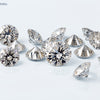

Leave a comment
Please note, comments must be approved before they are published.